
 Synthetic Amethyst
Consumer Information
What color is it?: Synthetic amethyst is the same violet to purple color as its natural counterpart. Few other synthetic or "created" gemstones so closely emulate their natural counterparts as synthetic amethyst does natural amethyst.
What is the story behind this gemstone?: Synthetic quartz has been around for decades. In fact it is the synthetic quartz industry that made quartz watch movements possible. The sad part about this gem material is what it has done to the market for fine quality, natural amethyst. The synthetic so closely emulates the natural, and is so very difficult to distinguish from the natural, that market prices have fallen dramatically for amethyst due to lack of consumer confidence of what they are buying. In fact, even the GIA has difficulty in separating synthetic amethyst from natural without some very high tech equipment, so you know it is very, very good.
Source: Most synthetic amethysts are produced in Japan and Russia, although other sources are available and will certainly be added here if I have missed listing them.
Chemical: Synthetic amethyst has the same chemical composition is natural amethyst: SiO2 a silicon oxide
Formation: By hydrothermal growth around a seed crystal (see below)
Crystal System: Trigonal
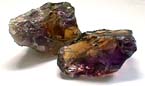 Unusual
Properties: Recent developments
has allowed the first formation of bi-colored quartz or ametrine:
yellow citrine and purple amethyst grown together in the same
crystal by Russia. (see photo at left)
Unusual
Properties: Recent developments
has allowed the first formation of bi-colored quartz or ametrine:
yellow citrine and purple amethyst grown together in the same
crystal by Russia. (see photo at left)
 Gemological
Information and Identification
Gemological
Information and Identification
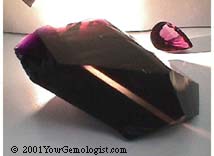
A hydrothermal growth block of synthetic amethyst showing the colorless seed plate around which the block grew. In the background is a 63.00 carat natural pear faceted amethyst.
Primary Test: Inclusions
Synthetic amethyst will best be identified by bread crumb type inclusions...when they can be found. Additional diagnostic testing my inclusions and magnification can be done using the natural inclusions of amethyst (See Gueblin: PhotoAtlas of Inclusions in Gemstones) However, in spite of Brazil Law twinning being reported as diagnostic as separation of natural and synthetic, the use of twinned seed crystals in synthetic amethyst causes this test to be questionable.